

America, America: A Midrash
Applying an old way of reading to the song that should be our national anthem.
America, America: A Midrash
O Beautiful, for spacious skies,
For amber waves of grain,
For purple mountain majesties,
Across the fruited plain.
America, America,
God shed his grace on thee,
And crown thy good with brotherhood
From sea to shining sea.
Before the song begins, the musicians, audience, ticket takers, and security guards become one the same way God brought life to a lump of clay in Eden: breath. This is where memory, hope, yearning, and meaning begin, the intake prior to thought. Here, arguments are a whisper, agendas a distraction, parties an absurdity, partisans an affront. Sacred song translates the Ultimate into shared meaning. In breath, we lift our voices.
O: What can be learned from a single letter? To the Jewish way of reading text, everything. Our tradition builds cathedrals of thought on the calligraphic crowns or scribal marks in handwritten Torah scrolls. The scroll even lacks punctuation, turning some sentences into mysteries. When a community names something “scripture,” we cannot disregard even a single letter. The words on the page are too holy to be ignored. We call this practice midrash, the search for meaning from texts we hold dear.
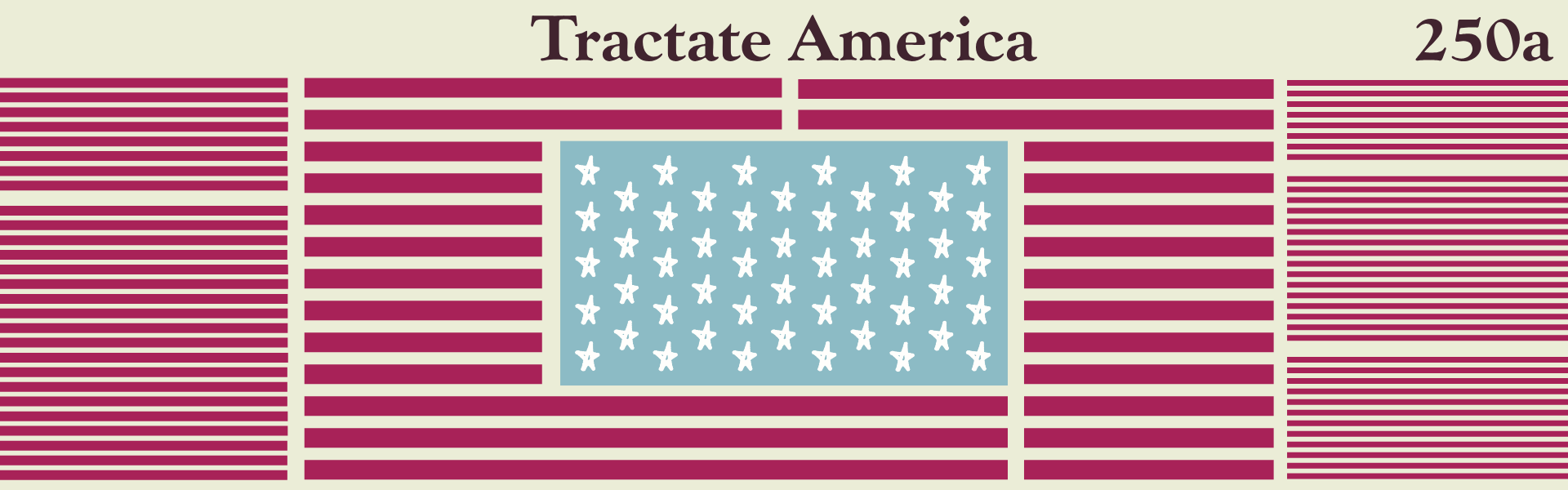
A different view: Over centuries, the midrashim (pl.) have accumulated as editors assembled multiple comments on a single page, an array of ideas, often disagreeing, each one hanging on a piece of the underlying text (the image above is a silhouette of a page of Talmud, with commentaries surrounding the central text). Thoughts collide, until we readers become participants in a culture of respectful dissent. Midrash says, just stay at the table, stay with the text, listen to another voice, then explain what you think this means, from your knowledge, your wisdom, your experience, your soul. Every explanation might be true; no one can claim certainty. Torah teaches that only Moses spoke to God “mouth to mouth.” The rest of us seek together. O . . .
Beautiful: This is patriotism at its most basic desire: to belong to something that adds beauty to the world. Yet beholders disagree. Our visions contradict. Where I see beauty, you see oppression, injustice, thought-control. Soon, we come to see our differences as threats. Arguments harden into ideologies or curdle into contempt. This is the challenge of beauty, to see America’s goodness, and to see your goodness no matter what you see as America’s beauty.
For Spacious Skies: I grew up in the spaciousness of Florida Bay, but you might insist on Montana, or the sliver of blue glimpsed between New York skyscrapers. We could just playfully debate the grandeur of my bays vs. your plains, my burning sun vs. your biting frost, but instead of play, our discourse has lost its spaciousness. We each claim to know the truth of this place, insisting on our specific vision of the sky, forgetting how tiny we are beneath the heavens. Can we rediscover humility?
For Amber: We yearn to capture America in gold sap, locking in a vision of what came before. One half of us longs for the progress of a prior time, the generation of increasing wealth, rights, freedom, or equality. The other half longs for a different prior time, a time before change, a stasis of good and true Americanness. This is the human way, but nostalgia is literally memory-pain. As we stare into America frozen in amber we become frozen and encased. Instead, let us see America through the rippled translucence, and learn from it like a scientist pulling DNA from the past.
Waves: One of my earliest memories is playing in the waves of at my grandparents’ Beach Club on the south shore of Long Island, a place with tiny cabanas just behind the elevated boardwalk, where old Jews, mostly Germans descended from long-assimilated families, ordered lunch from cabana boys, the descendants of Romans or German Crusaders, while drinking Scottish liquor on Wamponomon land, just down the beach from where Robert Moses lowered the overpasses on the access roads to block public buses filled with African Americans. We are the waves crashing against one another.
Of Grain: Bread is the symbol of civilization, hard earned knowledge passed from generation to generation to harvest seeds of the grass, grind it, add water, let it soak up airborne yeast, knead it, let it sit some more, then punch it down, then let it sit again, then bake it. America is built on thinkers, strivers, dreamers and philosophizers. Our civilization makes bread in quantities that medievals and ancients could never imagine, bread with so many zeroes the mind strains to understand. We have inherited the ideas, wealth, and political system, crafted by generations. What can we add?
For Purple: Royalty. We threw off His Majesty, but the human need for Sovereignty did not disappear. Instead of an English King, America made every man sovereign. Liberty!
A different view: They meant “man” literally — and not even all men at that — simultaneously claiming and denying the divine right to sovereignty. Complicating their cries of “freedom” is the reality that in a democracy we all must accept the possibility of loss in the next election. This is a strange kind of sovereignty, one whose very power lies in its limitation. The One made each one equal, unable to dominate any other one. This is our noblity. Black, White, Red, Blue, we must all be a little purple.
Mountain Majesties: When Katharine Bates, a devout Christian, gazed out from Pike’s Peak, surely she thought of the high places where Abraham proved his faith, Moses received the law, Elijah heard the still small voice, Jesus gave his famous sermon, and Mohammed ascended to heaven. The mountains testify that beyond human events lies Eternal Truth. Her lips burned with awe and the potential of the American project.
A different view: Staggering beauty into which we punch holes to extract riches.
Above: This place was meant to be above all others, the “city on a hill,” that Jesus predicted. Salem, is one of the most common place names in America, a land meant to be Jerusalem. We are to elevate humanity, transform history, climb up to a moral purpose. When George Washington assured the Jews of Newport, RI, that they were indeed the very America from which they sought welcome, he ended with the vision of Prophets, “that all men shall dwell in peace beneath his vine and fig tree.” Our prophets proclaim, “All men are created equal”; “We the people, in order to form a more perfect union”; “Government of the people, by the people, for the people;” “Give me your tired, your poor,” “I have a dream!” “Tear Down this Wall!” States are mere human things, the tools of group survival. This place is supposed to be different, above the normal ways of statehood.
Fruited: Fruit brings nourishment, but it can also rot and smell. In East of Eden, Steinbeck’s paean to California, the place at the far end of the American rainbow, fertility burdens us with choice. Beneath our parking lots and skyscrapers lies the soil of spruce-covered Cascades, southern Pines, fed by roaring Colorados and whispering Shenandoahs. A fluttering Presence dwells in this land, its Truth unaffected as we gorge ourselves on the fruits of our history. Now, that Presence speaks, testifying to the generations of violence done here, and the stench of rot rises around us. We write our destiny in how we face this past and chose our future: Timshol.
Plain: Nothing about this place is plain. Beneath every story, every song, lies another layer of meaning. We have inherited an entity, a state, a commonwealth, almost a quarter millennium old. Common sense tells us that what got us here will surely not bring us forward, yet what got us here built a wonderous place, even if immense suffering abounds in this land, grievance and resentment pinging Hamilton-Jefferson-like from either side of the political spectrum. We continue to hold certain truths as self-evident, while generation after generation of ever-more-diverse peoples arrive and thrive. We endeavor to create here something that has never been done before in human history: a truly multi-ethnic, multi-religious, multi-racial, potentially a multi-lingual democracy spanning an entire continent. And we do so by standing on the shoulders of people to whom we owe gratitude, and from whom we have inherited grave injustices. Nothing about this place is plain. So if we are to take one more step forward, given all this complexity, we will need a language, a vocabulary, a vehicle capable of carrying intricate conversations and audacious aspirations. Screens and apps will betray and manipulate us toward the simple binaries that feed their algorithms. To imagine the America we want requires us to invent (or, perhaps, reinvent) a technology of thought and method of finding shared truth, one worthy and able to contain our multitudes and contradictions.
America! America!
Like the angel who called, “Abraham, Abraham,” this song calls to us to wake up, repeating our name twice, and asking us to put down the knife hanging over the future’s neck. We are so entranced with our idolatries. We believe so firmly in our economic survival that we skip family dinners with our children. We believe so firmly in our right to bear arms that elementary schools are now high-risk zones. We believe so firmly in our capitalism that we accrue personal, national, and ecological debt like children collecting candy on Halloween. The angel may have to shout at us, “America! America!” to penetrate our airpods and casino machines so we can face the choices before us. The question is how.
A different view: There never was and never will be only one way to understand America.
God: Put aside specific dogmas or assertions of belief or disbelief. See God simply as ineffable Oneness (Deuteronomy 6:4). A Unity we cannot entirely understand. Everything else is fragmented. The next line of Torah (6:5) begins, “And you shall love . . .” This American project relies upon God because in our massive diversity we argue over the truth. Yet, we must love. We disagree about what just happened or will happen or is happening right now. Yet, we must love. To decide what sacrifices we must make to keep America going (because everything costs something, and somebody, somewhere pays the bill), we must bridge division without erasing it. Even if division is or feels existential, a threat to the survival of one’s children or grandchildren, we must love. The bridging is an act of massive devotion to the other with whom one disagrees. We must reserve, even in our most passionate arguments, the possibility that the other is right. We start with love.
Shed: A place to store tools for yardwork. Whether ancestral, immigrant or enslaved, America began with tools, hands and muscle. Labor gets us out of our heads, to a confrontation with our shared reality, into work with each other. We will need that kind of collective physical exertion to untangle the political and philosophical knots we’ve created in this place.
A different view: Shed is a pandemic word: the way I spread noxious particles to the world around me. We shed ideas as well. Cynicism, despair, anxiety. (Can we shed the positive particles too, like the happy pheromones that pass between lovers? Hope, duty, devotion, pride, belonging.) Despite our addiction to the mirage of absolute independence, we are always shedding. We accept interdependence.
His: The present-day conversation about pronouns, one that has turned into mockery of the “woke,” is really a question about the power to define the self. We cannot escape the truth that certain men have hoarded power and some continue to wield it to define others. The ripples of 1619 and 1776 crash over us. Oppression is part of what made this amazing place possible. That is the hard problem we must eventually face. Mockery is avoidance.
Grace: If we are to be patriotic, to love our nation with integrity, what we love will, at times, put us at odds with one another. Bates wrote “America, the Beautiful,” in living memory of Civil War. Carnage was real. The song poem does not ask God to shower us with grace, that is, underserved blessings, but rather to shed upon us the power to offer grace to each other. As political violence grows around us, can we instead, when faced with our differences, choose grace?
Crown thy good: This phrase rejects the nihilism of our age, the product of relentless online disorientation, social alienation, cultural deterioration, worship of celebrity and influence, postmodern relativism, and institutional collapse. To reclaim our crown, we will have to rebuild our belief in goodness. In all my work as a local neighborhood clergyman, I find a universal hunger for the good. It crosses all boundaries. A rebirth of American civic life starts in the conviction that we must work for the good, and especially when our definitions of goodness differ, we cannot be afraid to seek and sustain it.
Brotherhood: The original, 1893, version of this poem concludes the first verse with, “Til souls wax fair as earth and air.” Note the focus on personal salvation. In 1911 Bates changed the words to shift emphasis from individual to collective redemption. Brotherhood. We cannot allow our quests for self-help, personal growth, or even theological absolution, to overshadow our obligations to restore the American whole.
From Sea to Shining Sea: Immigrants have crossed the sea dreaming they would find streets of gold. An African American therapist once told me of clients who dreamt of ancestors drowned in the Middle Passage. Generations have come by choice or by force. The ocean deep holds billions of dreams. We must confront these varied realities if we are ever to find brotherhood, grace, fertility, nobility, and beauty. We are both the voices lost beneath the waves, and the droplets of light shining on the horizon.
America, America.
Michael this is GORGEOUS! Thank you this and for creating Faith250. I love how you weaved Jewish principles throughout.